If you’re comparing quotes for a custom home, renovation or extension and one builder has come in significantly lower than another, it’s easy to assume you’ve found a bargain. In our experience, that’s rarely what’s actually happening.
The cheaper quote can look very good up front, then grow substantially through variations, omissions and allowances that don’t reflect your actual selections. The higher quote can feel hard to justify, even when it includes things the lower one has simply left out. The key is to stop asking “which quote is the cheapest?” and start asking “am I actually comparing the same scope?”
1. The scope is rarely the same
This is the most common reason quotes vary, and the hardest one to spot without looking carefully. Even when two builders are cost planning from the same set of plans, they may not be cost planning the same level of detail or the same range of work.
One builder’s quote might include full site establishment, demolition or clearing, excavation allowances, stormwater works, upgraded waterproofing, better window and door specifications, more realistic electrical and plumbing allowances, painting, flooring, or external works that another builder has exlcuded entirely, The second builder may have left those items out - sometimes intentionally, sometimes because the documentation didn’t make them explicit enough to force a decision either way.
Neither builder is necessarily doing the wrong thing. But the final numbers can look very different, and until you go line by line through both quotes you won’t know whether you’re comparing a fully scoped project to a partially scoped one.
2. Allowances can make a cheap quote look better than it really is
Allowances are one of the most reliable traps in residential building, and they’re worth understanding in detail. When a quote includes an allowance for kitchens, joinery, tapware, tiles, lighting, or appliances, it’s using a placeholder figure rather than cost planning your actual selections. The overall cost can look sharp at the start. The problem appears later, when your real selections don’t match those placeholder figures and the difference becomes a variation - an additional cost on top of what you signed.
The more detailed your selections are before cost planning begins, the more reliable the quote will be. A builder who asks good questions about your expectations early, and budget expectations to your actual brief rather than a generic placeholder, is generally giving you a more honest number - even if it’s higher.
3. Site costs are not equal from one project to the next
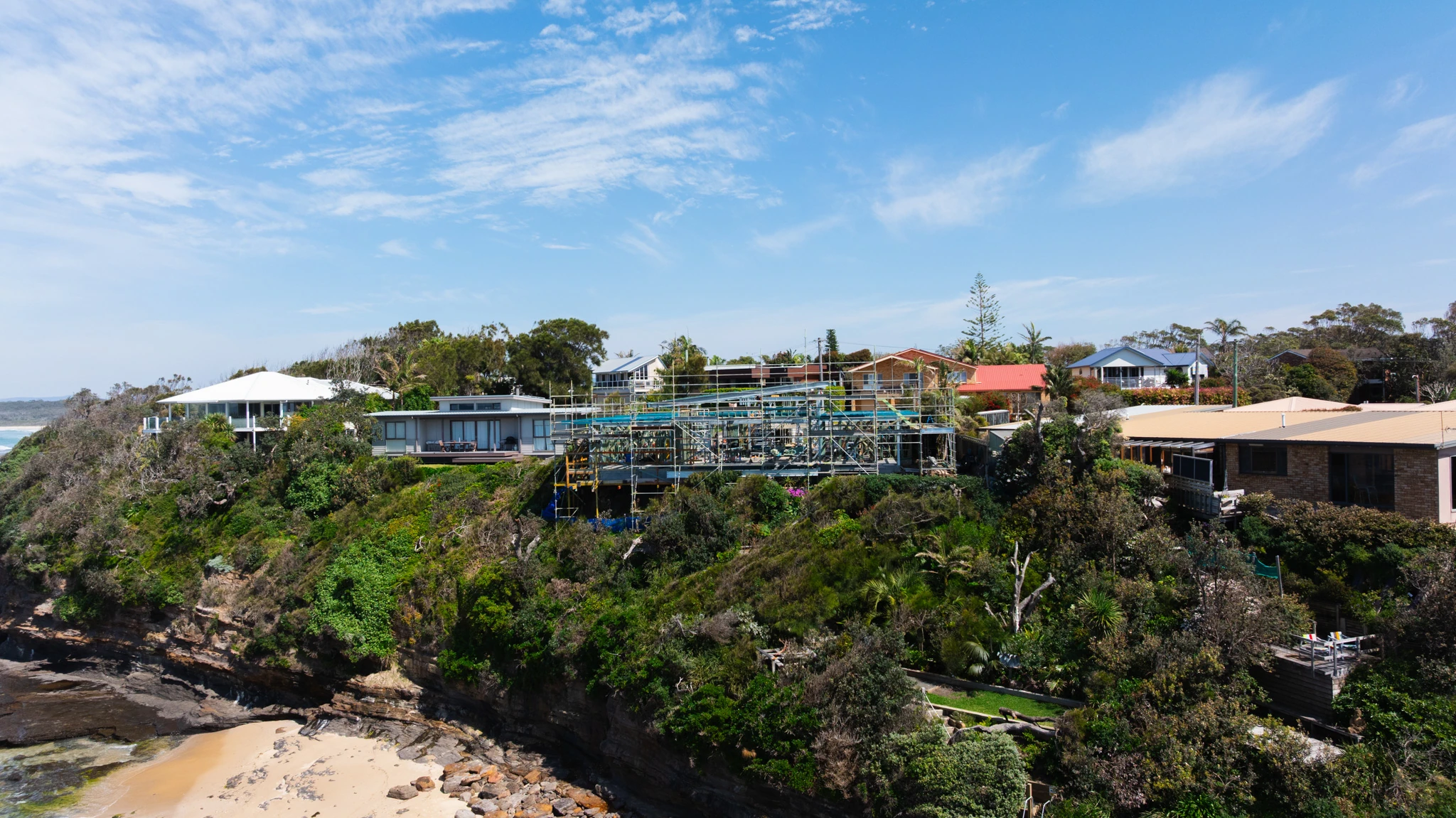
In coastal areas like Shoalhaven, site conditions have a significant and highly variable effect on building costs - and they’re one of the areas where quotes more commonly diverge. A flat, easy-access block with good soil conditions is a fundamentally different proposition to a sloping block, a tight-access site, a waterfront property, or a renovation where the existing structure contains unknowns.
Costs can shift considerably depending on excavation requirements, rock removal, drainage and stormwater management, retaining structures. access for machinery and deliveries, corrosion protection requirements near the coast, existing structural conditions in a renovation, and bushfire, flood, or BAL requirements that apply to the site.
If one builder has properly assessed and allows for those site-specific risks and another has used generic or optimistic figures, the quotes will not be comparable - and the cheaper one will catch up with you during construction. This is also where genuine experience with coastal and complex sites makes a material difference. Builders who have worked extensively in this environment cost with fewer assumptions and more site-specific knowledge. That can make the upfront number look higher, but it substantially reduces the risk of expensive surprises later.
4. The level of detail behind the walls matters
A significant portion the of cost difference between a thorough quote and a lean one isn’t in the finishes you can see - it’s in the work you’ll never see once the plaster goes on. Moisture management systems, flashing details, cavity construction, membrane detailing, insulation strategy, window installation methods, corrosion resistant fixings, and air sealing all affect the long-term performance and durability of a home. None of the them are visible after completion, but all of them matter.
For a standard project home on a simple suburban block, some of these details can be fairly minimal without serious consequence. For a custom coastal home, a major renovation, or a high-performance build in the Shoalhaven, they matter considerably more - and the difference between getting them right and not is a home that holds its value and performs well for thirty years as opposed to one that starts showing problems within a decade.
A quote that properly allows for long-term durability, better moisture control, and more carefully planned construction will often be higher than one that budget expectations to the bare minimum. That’s not overpricing. That’s a different build standard, and it’s worth understanding which one you’re being offered.
5. Engineering, compliance and documentation gaps change everything
The earlier in the design process a quote is sought, the more assumptions a builder has to make to fill in gaps. If you’re asking for cost planning from concept plans or incomplete drawings, you’re generally not getting a true like-for-like comparison - you’re getting each builder’s best guess at what the unknowns will cost, and those guesses can vary significantly depending on how conservative or optimistic each builder chooses to be.
Items that aren’t yet resolved but will affect the final cost include structural engineering, hydraulic design, energy requirements, BAL ratings and bushfire construction costs, acoustic requirements where relevant, window and glazing performance specifications, and any conditions imposed by council or a private certifier during the approval process. Until those pieces are resolved and priced, a quote is only as reliable as the assumptions behind it. A builder who carries conservative allowances for unknowns and one who keeps the number lean to stay competitive will look very different on paper, but only one of them is giving you a realistic figure.
6. Builder experience and process are part of what you’re paying for
Not all of the cost difference between quotes comes down to materials and labour. A builder with stronger systems, clearer communications, better scheduling, and tighter subcontractor management may cost differently to someone running a leaner operation with less structure - and the difference in experience shows up in ways that are genuinely valuable to a client.
This can manifest in how detailed and transparent the quote document itself is, how clearly exclusions are listed, how variations are identified and communicated, how realistic the programme is, how regularly the client is kept informed, and how problems are handled when something unexpected arises. For most homeowners undertaking a major renovation or a custom home, these things matter enormously. A build is a long process and the relationship with your builder will be tested at some point. You are not just buying a finished product - you are also buying the processit takes to get there, and that process has a real value that doesn’t always show up in the bottom line.
7. The cheapest quote is not always the cheapest build
This is the part that many clients learn the hard way, and it’s worth being direct about. A lower starting number can absolutely end up being the more expensive path if it leads to repeated variations as excluded items are added back in, incomplete scope that requires rework or additional contracts, quality issues that need to be rectified, delays caused by poor scheduling or subcontractor management, and ongoing confusion about what was and wasn’t included in the original agreement.
A more detailed, higher quote may feel harder to justify at the start. But it can give you a much clearer picture of the real cost of the project - and clarity at the start is worth considerably more than surprises during construction, when your opinons are limited and your leverage is gone.
How to compare builder quotes properly
When you’re reviewing quotes side by side, these are the things worth examining before you make a decision:
Compare inclusions and exclusions carefully. Don’t compare bottom lines. Go through each quote line by line and understand what is included, what is excluded, and what is covered by an allowance.
Scrutinise the allowances. Are the allowances figures realistic for the level of finish you want, or are they placeholders that will grow once you make real selections? Ask the builder to walk you through the major allowances and explain what they’re based on.
Look for missing site costs. Has excavation, drainage, access, demolition, retaining or external works been properly addressed? On a coastal of sloping site in the Shoalhaven, these can be material costs.\
Ask how unknowns have been handled. If documentation is incomplete, what assumptions has each builder made? A builder who is explicit about their assumptions is generally giving you a more honest picture than one who hasn’t acknowledged them.
Look at the level of detail in the document itself. A short quote with a low total may not be more efficient - it may simply be less complete. The detail in a quote document reflects the details with which a builder has actually though through your project.
Ask how variations are managed. No build goes perfectly to plan, particularly renovations. The questions isn’t whether variations will arise - it’s how clearly and promptly they are communicated and agreed before work proceeds.
A better approach before you lock in a builder
If you want the most accurate picture of what your project will actually cost, the most effective step is to invest more time getting the documentation and scope right before you ask for a clearly scoped. The more resolved your design, the more detailed your selections, and the more thoroughly your site condititions have been assessed, the less room there is for builders to make different assumptions - and the more comparable the quotes you receive will be.
This is where Early Contractor Invlovement has genuine value. Rather than finalising a design in isolation and then sending it out to tender and hoping the numbers come back where you need them, the ECI approach brings a builder in during the design phase to work through buildability, identify scope gaps, assess site-specific costs, and develop a realistic budget before construction to documentation is complete. By the time a clearly scoped is agreed, the major variables have been examined and the quote is build on real information rather than assumptions.
It also eliminates much of the friction that comes from clients, designers, and builders all working from different expectations. Everyone is aligned on what is inclused, what is costs, and why - before anyone commits.
A final word
If one builder quote is significantly cheaper than another, the right response is not to assume you’ve found a bargain. It’s to understand why. Usually you are looking at a different scope, different assumptions, or a different standard of build - and the difference matters.
The right question to ask is not “who is the cheapest?” It’s “who has priced the properly, clearly, and honestly?” That’s what actually helps avoid surprises during construction, and it’s the basis on which a project of this size and significance deserves to be decided.
If you are planning a custom home, major renovation, or a coastal build in the Shoalhaven and you want genuine clarity around scope and budget before you commit, we’re happy to work through it with you. Start with a conversation, review the documentation together, and get clear on what is actually included before making the right call.